Bee Cave, TX Custom Home Building
Building a custom home in Bee Cave, TX means working with Hill Country geology, sloped terrain, and a permitting environment unlike anything you encounter in central Austin. Limestone bedrock, mature live oaks under preservation ordinance, and subdivision-specific HOA design standards all have to be addressed before ground is broken. At Mission Home Builders, we bring the engineering discipline and process rigor that Hill Country builds require. Whether you have a lot already or you are still looking, we can help you navigate what it actually takes to build here
Why Families Choose Bee Cave
Hill Country Living, Austin Proximity
Bee Cave occupies a narrow stretch of West Travis County at the intersection of SH-71, FM 620, and FM 2244, roughly 14 to 16 miles west of downtown Austin. Under normal conditions, SH-71 puts you downtown in 20 to 30 minutes. The city sits in genuine Hill Country terrain, with elevations ranging from 875 to 1,025 feet, rolling limestone ridges, creek drainages, and a developed tree canopy that most Austin neighborhoods do not have.
What draws people to Bee Cave is a quality of place that is hard to find at this distance from a major city. The Hill Country Galleria anchors the commercial core with upscale retail and dining. The Backyard, a 3,700-seat outdoor amphitheater, sits adjacent to it. Lake Travis is 10 to 15 minutes away. Hamilton Pool Preserve, one of the most visited natural areas in the region, is about 20 minutes out. The Barton Creek Habitat Preserve borders the western edge of the city. For families who want outdoor recreation woven into daily life, Bee Cave delivers.
The School District Is the Draw for Families
Bee Cave is served entirely by Lake Travis ISD, ranked 50th out of 961 Texas school districts (SchoolDigger). Schools serving Bee Cave residents include:
Bee Cave Elementary: Top 13% of Texas elementary schools, with proficiency rates roughly 15 to 20 points above state averages in both reading and math (SchoolDigger, 2024-2025)
Bee Cave Middle: Ranked 66th of 2,361 Texas middle schools; 74% math proficiency, 78% reading proficiency versus 41% and 51% state averages (SchoolDigger, 2024-2025)
Lake Travis High School: Ranked in the top 10% of Texas high schools, with a 96.8% four-year graduation rate (SchoolDigger, 2024-2025)
Who Lives Here
Bee Cave draws high-earning professionals and executives seeking Hill Country living without sacrificing Austin access. Median household income is approximately $113,593, with per capita income near $96,977 (ACS 2023). About 24.7% of residents are under 18, and the poverty rate is just 2%. The demographic profile is consistent across communities: dual-income households, often with children, who relocated from higher-cost markets and found that Bee Cave's lot sizes, school quality, and natural character could not be matched inside the Austin city limits at comparable price points.
What to Expect from the Real Estate Market
Bee Cave sits at the higher end of the Austin metro market. New custom builds typically range from $1.2M to $3M+, depending on lot type, community, and finish level. Estate communities like Spanish Oaks and The Homestead operate in a different price category than the suburban master-planned subdivisions, and pricing reflects that distinction. Lot values alone can range from $300,000 in established suburban communities to $1.5M+ for premium acreage with Hill Country views.
Building in Bee Cave: What You Need to Know
Governing Jurisdiction
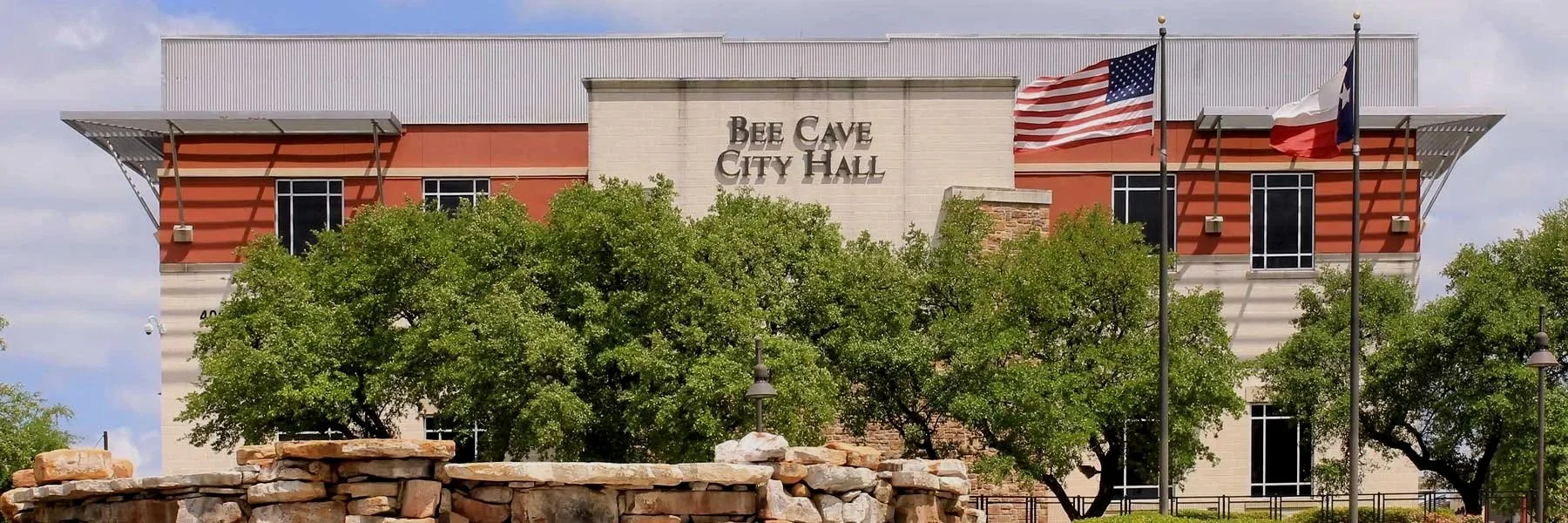
Permitting for properties within Bee Cave city limits is handled by the City of Bee Cave Planning and Development Department, located at 4000 Galleria Pkwy (512-767-6675). Permits are submitted through MyGovernmentOnline, the city's online portal. Contractors must complete annual registration with the city ($50 fee) before any permit can be issued. Properties in Bee Cave's Extraterritorial Jurisdiction (ETJ) are only subject to platting, water quality, and signage regulations, not full zoning. Confirm city limits status for each parcel before design work begins.
Zoning Requirements
Bee Cave adopted its first Unified Development Code (UDC) in June 2022, consolidating all land development regulations. Primary residential zoning districts:
| District | Intent | Density | Common Lots |
|---|---|---|---|
| R-1 | Estate/rural residential | ~1 unit/acre or less | 0.5–5+ acres |
| R-2 | Suburban residential | 1–2 units/acre | 6,000–22,000 sq ft |
| R-3 | Suburban transitional | 3–5 units/acre | Smaller infill |
| AG | Agricultural (newly annexed) | Rural/pre-development | Acreage |
| PDD | Planned Development District | Per specific ordinance | Spanish Oaks, Falconhead, etc. |
Dimensional standards for single-family residential (R-1 and R-2):
| Standard | R-1 / R-2 Requirement |
|---|---|
| Front setback | ~20 feet |
| Side setbacks | 10–15 feet (varies by zone) |
| Rear setback | 10–15 feet (varies by zone) |
| Max height (SFR) | 35 feet |
| Max impervious cover (SFR) | 50% |
| Max impervious cover (commercial) | Up to 70% |
| Minimum lot area | Varies by district; R-1 typically 0.5+ acres |
Critical: A large number of Bee Cave lots sit inside Planned Development Districts (PDDs) such as Spanish Oaks, Falconhead, Provence, and Sweetwater. Each PDD carries its own design standards and dimensional requirements layered on top of the base UDC. Always pull the specific PDD ordinance for the lot in question. Both documents apply simultaneously.
Our approach: We pull the base UDC and the applicable PDD ordinance for every site and conduct a pre-design compliance review before architectural work begins. This prevents costly redesigns mid-permit.
Soil Conditions and Foundation
This is the most significant building difference between Bee Cave and the central Austin neighborhoods. Bee Cave sits on Hill Country limestone geology, not Blackland Prairie clay. Shallow soils over limestone bedrock are the norm, often just 1 to 3 feet of topsoil before hitting solid rock.
Rock excavation is standard, not exceptional. Foundations, utility trenching, and pool excavation routinely encounter solid limestone. Specialized rock-breaking equipment is required, and some sites require controlled blasting. Budget $5,000 to $15,000 or more for rock removal depending on depth and site conditions.
Foundation behavior is more stable than Austin clay. Limestone provides excellent load-bearing capacity and minimal seasonal movement. The shrink-swell foundation problems common in east and central Austin neighborhoods do not apply here.
Geotechnical report is still standard practice. Post-tension or conventional reinforced slab is used depending on conditions. Pier and beam foundations appear on steeply sloped lots where the structure is elevated off the hillside.
Karst awareness. Hill Country limestone is karst geology. Underground caves, fissures, and aquifer channels are possible. If karst features are encountered during excavation, TCEQ notification and potential project redesign may be required.
Our approach: We engage geotechnical consultants early on every Bee Cave project and scope rock excavation into the initial budget, not as a change order. Foundation type is decided based on site-specific conditions, not a default template.
Topography and Drainage
Bee Cave is hilly. Elevations within the city span from roughly 875 to 1,025 feet, and many residential lots carry grade changes of 20 to 40+ feet across the buildable envelope. This terrain creates both opportunity and complexity.
Sloped and terraced lots are common in Spanish Oaks, The Homestead, Signal Hills, and other communities. Views are a premium, but elevated lots require structural solutions a flat lot does not.
Retaining walls, stepped foundations, and graded driveways add cost that builders unfamiliar with Hill Country terrain consistently underestimate.
Stormwater that accelerates down limestone hillsides channels into Barton Creek and its tributaries. Drainage engineering is required on most sloped sites and is reviewed at plan submittal.
Some lots near Barton Creek corridor drainages carry floodplain exposure. Each parcel should be checked against FEMA flood maps before design work begins.
Our approach: Drainage and grading engineering are part of our standard process on every Bee Cave project, not an afterthought. We identify floodplain exposure, retaining wall requirements, and drainage design needs during initial site evaluation.
Tree Preservation
Bee Cave has a meaningful tree preservation ordinance under UDC Section 6.1, adopted in 2022 and amended in 2023 and 2024. The rules carry real teeth:
60% caliper-inch preservation requirement: All development must preserve or replace at least 60% of the caliper inches of trees present on site prior to development, as documented by a required Tree Survey.
Protected, Significant, Specimen, and Heritage Trees: All categories require a Tree Removal Permit from the Building Official before removal or alteration.
Critical Root Zone (CRZ) protection: No storage, grading, trenching, or equipment parking within the CRZ of preserved trees without prior approval. Violations during construction can result in permit revocation.
Tree Survey required with all Site Plan applications: Must identify all trees 4"+ caliper by species and size.
Oak Wilt risk is active in Bee Cave: Avoid pruning oaks from February through June. Any oak pruning requires immediate wound paint application. The city has a specific tree pruning ordinance addressing Oak Wilt transmission.
Our approach: We engage a certified arborist during site evaluation, before design is finalized. Tree Survey is submitted as part of the Site Plan package. We design building footprints, utility routes, and driveways around preservation zones from the start.
HOA and Subdivision Design Standards
Bee Cave does not have a citywide HOA. However, virtually every established master-planned community within city limits has its own HOA with an Architectural Review Board (ARB). HOA approval is separate from city permitting and is not bound by city timelines.
Spanish Oaks: Mandatory, active ARB. Guard-gated. Strong design standards enforced. No MUD tax overlay.
Falconhead / Falconhead West: Mandatory HOA, reasonable fees (~$150-250/month). Most established family community. No MUD tax.
The Homestead: Minimal HOA restrictions. Large acreage lots. Equestrian-friendly. Some portions carry MUD tax.
Provence, Sweetwater: Mandatory HOA. Newer master-planned construction. Both carry MUD tax overlays that can add $3,000-$5,000 per year in property tax burden.
MUD Tax Due Diligence: Multiple Bee Cave communities carry Municipal Utility District (MUD) tax overlays. Spanish Oaks and Falconhead do not. Over a 20-year ownership period, the difference can exceed $80,000. This is a material consideration that affects lot selection.
Environmental: Edwards Aquifer and Impervious Cover
Parts of Bee Cave's drainage area contribute to the Barton Springs segment of the Edwards Aquifer. Development in contributing zones may be subject to TCEQ Chapter 213 Edwards Aquifer Protection Program requirements, including stormwater management and impervious cover restrictions.
Bee Cave applies impervious cover limits and water quality management requirements through the Highland Lakes Watershed Ordinance (LCRA) for certain areas.
Aquifer zone status must be verified for each parcel via the TCEQ Edwards Aquifer Map Viewer before drainage and impervious cover are designed.
Bee Cave is also a designated International Dark-Sky Community. Exterior lighting must be shielded and downward-facing. This affects exterior design and landscape lighting planning.
Permitting Timeline
Bee Cave's Planning and Development Department is smaller and typically faster than Austin's AB+C system. State law requires the city to respond to a building permit application within 45 days. Realistic timelines for a well-prepared custom home permit package:
Building permit (straightforward site): 6 to 10 weeks from complete submittal
Site Plan (if required): Add 4 to 8 weeks
Tree Survey review: Integrated into Site Plan review timeline
HOA architectural approval: 2 to 8 weeks depending on the ARB; run concurrently, not sequentially
Total realistic window from full submittal to permit in hand: 8 to 16 weeks for a well-prepared package. Incomplete submittals or corrections significantly extend this timeline.
Construction Costs
Construction costs in Bee Cave reflect the Hill Country site conditions, premium lot values, and the high finish expectations of the market. Typical ranges for a custom home:
Lot: $300,000 to $1.5M+ depending on community, lot size, and views
Construction cost: $325 to $500+ per square foot for a fully custom build, depending on finishes, site complexity, and structural requirements
Rock excavation allowance: $5,000 to $20,000+ (priced into the budget, not treated as a change order)
Retaining walls: $50 to $150+ per linear foot depending on height and material; significant on sloped sites
Total project range: $1.2M to $3M+ for most custom homes in master-planned communities; estate builds on larger lots can exceed $5M
Bee Cave Quick Facts
| Category | Details |
|---|---|
| School District | Lake Travis ISD (ranked 50th of 961 TX districts) |
| Median Home Value | ~$815,808 (ACS 2023) / ~$957K typical (Zillow 2025) |
| Median Sale Price | ~$923K–$1.0M (early 2025) |
| Price per Sq Ft | ~$293–$322 (early 2025) |
| Typical Lot Sizes | 6,000–12,000 sq ft (suburban); 0.5–9+ acres (estate) |
| Zip Codes | 78736, 78738 |
| Distance to Downtown | ~14–16 miles west / 20–30 min (SH-71) |
| Population | ~8,510 (2024 estimate) |
| Jurisdiction | City of Bee Cave |
| Zoning (primary residential) | R-1, R-2; PDDs vary by subdivision |
| Property Tax Rate | ~1.2% base (MUD districts add $3,000–5,000/yr) |
Sources: Zillow, Redfin, Rocket Homes, Orchard, SchoolDigger, City-Data, City of Bee Cave UDC, Travis CAD. Updated March 2026.
Why Choose Mission Home Builders
Custom Home Building Made Easy
Mission Home Builders was founded by Nic Andreani, a licensed Professional Engineer with 20+ years of construction experience, and Schuyler, a top 1% Austin realtor. Our team has built over 554 homes across our careers with a combined 79+ years construction experience. That background shapes a process built around one goal: making custom home building predictable and stress-free.
Whether you are starting from scratch or already have plans, Mission Home Builders can handle the entire project from A to Z, including lot selection if you still need one. You bring the vision. The team takes care of the rest.
Engineering Discipline Applied to the Building Process
Nic's engineering background means nothing falls through the cracks. In Bee Cave, where limestone rock excavation, sloped site drainage, HOA ARB approvals, tree preservation compliance, and MUD tax due diligence all have to be managed in coordination, that discipline matters.
Geotechnical consultants, structural engineers, certified arborists, and drainage engineers selected and coordinated for each site
Pre-permit zoning and PDD ordinance compliance review before City submittal
Rock excavation and drainage management budgeted from day one, not added as change orders
HOA ARB submission sequenced and tracked alongside city permitting
MUD tax exposure and taxing entity research conducted during site evaluation
A Clear, Transparent Process
Mission's step-by-step system keeps projects on time, on budget, and fully transparent from the first conversation to the final walkthrough. Weekly updates, one point of contact, and client portal access mean no guessing, no chasing, and no surprises. Our Leadership team is personally involved from site evaluation through final walkthrough, backed by a field team with 79+ years of combined experience.
Bee Cave overall is a great place to build a custom home. If you are thinking about building here, let's talk. Mission Home Builders can help at every stage, from finding the right lot to delivering the finished home. We will walk through your project, explain exactly what the site conditions and permitting requirements mean for your design, and help you figure out what is possible and what it will cost.