Crestview, TX Custom Home Builder
Building a custom home in Crestview means working within one of Austin's most regulated residential frameworks. Every new single-family build in the neighborhood falls under Subchapter F of Austin's Land Development Code, which constrains massing, FAR, and enclosed square footage in ways that suburban jurisdictions simply do not. Layer in Austin's tree preservation ordinance, expansive Blackland Prairie clay soils, and infill lot geometry, and you have a project that rewards builders who prepare before design begins. Mission Home Builders brings the engineering discipline and regulatory fluency to navigate all of it without surprises
Why Crestview Attracts Custom Home Buyers?
A Central Austin Neighborhood With Deep Roots
Crestview was developed in the late 1940s and 1950s on what was once a working dairy farm north of Austin. Developer A.B. Beddow built the neighborhood street by street, and the Crestview Shopping Center opened in 1948, the same year many of the surrounding lots were first sold. Most original buyers were veterans using the GI Bill to buy modest ranch-style homes on generous lots at the edge of the city. The city eventually grew around Crestview, and what was once suburban farmland is now one of central Austin's most sought-after addresses.
The neighborhood covers about 1.2 square miles, bordered by Anderson Lane to the north, Burnet Road to the west, Justin Lane to the south, and North Lamar Boulevard to the east. The Crestview MetroRail station sits on the east edge, giving residents one of the few direct rail connections to downtown from a central Austin neighborhood. The shopping center that anchored the original community is still there: Fresh Plus Grocery, Little Deli and Pizzeria, and Top Notch Hamburgers (an Austin icon that appeared in the 1993 film Dazed and Confused).
Location and Commute
Crestview sits approximately 8 miles from downtown Austin, with typical drive times of 15 minutes or less under normal conditions. The Capital MetroRail Red Line provides direct rail access to downtown via Crestview Station. The neighborhood is also well-positioned between downtown and the Domain, putting residents roughly equidistant between Austin's two major employment and entertainment centers.
Schools
Crestview is served by Austin ISD through a strong feeder pattern that residents specifically seek out.
Brentwood Elementary School (K-5): A rating from Niche, 16:1 student-teacher ratio; located just across Justin Lane
Lamar Middle School (6-8): A- rating from Niche, 17:1 student-teacher ratio
McCallum High School (9-12): A rating from Niche, 18:1 student-teacher ratio; home of the AISD Fine Arts Academy (FAA), offering programs in choral studies, classical guitar, and performance theatre
What Makes It Desirable for Custom Home Buyers
Buyers who choose to build in Crestview are typically drawn to the combination of central location and lot size. Most Crestview lots range from about 5,700 to 10,000 square feet, larger than what you find in many central Austin infill neighborhoods. There are no HOA covenants, no ARB review process, and no mandatory design approval. The mature tree canopy, active neighborhood association, and walkable retail core give it a character that newer suburban neighborhoods take decades to develop. Buyers building here are typically choosing neighborhood quality of life over larger acreage, and they are willing to work within Austin's regulatory framework to get it.
Nearby Amenities and Recreation
Brentwood Neighborhood Park (pool, tennis, basketball, playing fields)
Beverly S. Sheffield Northwest District Park
North Austin Optimist Club baseball and softball fields
Yard Bar: Austin's first off-leash dog park with bar
Central Market (North Lamar, several miles south)
The Domain and Q2 Soccer Stadium (~10-15 min north)
Municipal Governance and Permitting
Crestview is fully within the City of Austin's jurisdiction. All permits go through the City of Austin Development Services Department (DSD), submitted via the Austin Build + Connect (AB+C) portal at austintexas.gov. There is no separate suburban permitting authority, no municipal utility district (MUD), and no contractor registration fee specific to Crestview.
Permitting authority: City of Austin Development Services Department (DSD)
Permit portal: Austin Build + Connect (AB+C) - austintexas.gov
DSD address: 6310 Wilhelmina Delco Dr., Austin, TX 78752
Phone: 311 (within Austin) or 512-974-2000
Building in Crestview - What You Need to Know
Zoning Requirements
The majority of Crestview is zoned SF-3 (Family Residence), the most common single-family zoning classification in central Austin. Standard development standards for a single-family home on an SF-3 lot are shown below.
| Standard | SF-3 Single-Family |
|---|---|
| Minimum lot size | 5,750 sq ft (standard); 1,800 sq ft small lot (HOME Phase 2) |
| Front setback | ~25 ft (or front yard averaging per Subchapter F) |
| Side setbacks | 5 ft interior, 10–15 ft street side |
| Rear setback | 10 ft |
| Maximum height | 35 ft (further constrained by Subchapter F tent provisions) |
| Maximum FAR | 0.40 for single-unit (within Subchapter F boundary) |
| Impervious cover | 45% maximum |
| Building coverage | 40% maximum |
Subchapter F - The McMansion Ordinance
Subchapter F of Austin's Land Development Code applies to all single-family new construction in Crestview. This is the regulation most commonly called the McMansion Ordinance, and it is the defining design constraint for custom homes in the neighborhood.
FAR cap of 0.40 for enclosed space, meaning a 4,000 sq ft home on a 10,000 sq ft lot represents the maximum under standard conditions
All enclosed space counts toward FAR: garages, lofts, and mezzanines are included; unenclosed carports and porches are not
Tent provisions: sloping height planes extend from side property lines, restricting two-story massing and bulk
Sidewall articulation requirements limit flat, unbroken wall planes
Subchapter F is waived for duplex, two-unit, and three-unit residential uses under Austin's HOME ordinance amendments (adopted 2023-2024). It remains fully in force for single-family custom homes.
Our approach: We coordinate architectural design around Subchapter F from day one. Garage placement, enclosed space accounting, and two-story massing decisions must be made early or you risk discovering FAR overruns late in the design process. Our team works closely with architects to optimize footprint within the constraints.
Soil Conditions and Foundation Design
Crestview sits on Blackland Prairie geology - specifically Taylor Black Clay, one of the most expansive soil types in Texas. This is the opposite of the limestone conditions found in Bee Cave or Westlake. There is no rock to excavate, but the clay presents its own engineering challenge.
Taylor Black Clay can shrink up to 30% in volume during drought and expand rapidly with rainfall
The active clay zone in central Austin extends 10 to 15 feet deep
Original Crestview homes were built on pier-and-beam foundations; new construction uses post-tension slab design engineered for expansive clay
Large mature trees, especially live oaks, interact with clay moisture levels through root competition and need to be factored into foundation design
Geotech report is standard and essential; soil bearing capacity and clay expansion data vary by parcel based on moisture history and drainage patterns
Our approach: We require a geotechnical report early in the project and coordinate with the structural engineer on post-tension slab design specific to Austin's clay conditions. Drainage design is also part of the foundation strategy. A slab that works on paper but drains poorly will develop problems over years of Austin's boom-and-bust rainfall cycles.
Topography
Crestview is relatively flat. The original dairy farm terrain was level to gently rolling, and there are no significant grade changes requiring retaining walls or hillside engineering for most lots. Foundation complexity in Crestview comes from soil behavior, not slope. Some low-lying areas near drainage corridors warrant flood zone verification, but this is not a primary concern for most Crestview lots.
Our approach: We verify flood zone status early using FEMA FIRM maps and the City of Austin Property Profile tool. For lots near Shoal Creek or drainage corridors, we confirm whether a floodplain development permit or additional engineering is required before design begins.
Austin Tree Preservation Ordinance
Crestview's 75-year-old tree canopy is one of the neighborhood's defining features, and Austin's tree ordinance is one of the most important regulations affecting custom home design here. The ordinance applies to all properties within Austin's full-purpose jurisdiction, which includes all of Crestview.
| Tree Classification | Diameter | Key Requirements |
|---|---|---|
| Regulated (preserve to extent feasible) | 8+ inches | Must be addressed in site plan applications |
| Protected Tree | 19+ inches (any species) | Permit required to remove; 100% caliper mitigation |
| Heritage Tree | 24+ inches (designated species) | Removal permit; variance required; 300% caliper mitigation |
| Metric | Detail |
|---|---|
| School District | Austin ISD |
| Key Schools | Brentwood Elementary (A), Lamar Middle (A-), McCallum High (A) |
| Zip Code | 78757 |
| Distance to Downtown | ~8 miles / ~15 min by car; direct MetroRail access |
| Jurisdiction | City of Austin, TX |
| Zoning (primary) | SF-3; Subchapter F applies to all single-family builds |
| Typical Lot Sizes | 5,700–10,000 sq ft (~0.13–0.23 acres) |
| Median Sale Price | ~$700K–$730K (Redfin, 2024–2025) |
| New Construction Range | $1.0M–$2.25M+ (MLS listings, 2025) |
| Property Tax Rate | ~2.05% (2025 tax year) |
| HOA | None – no neighborhood-wide HOA |
| Soil Type | Blackland Prairie / Taylor Black Clay (expansive) |
| Topography | Flat to gently rolling |
| MetroRail Access | Yes – Crestview Station (Red Line, Lamar / Airport Blvd) |
Sources: Redfin (home sale prices), Homes.com (demographics), Niche (school ratings, January 2026), City of Austin Land Development Code (zoning standards), Austin Real Estate Home Blog (property tax rate), Travis County Master Gardeners (soil conditions), City of Austin Tree Ordinance. Updated March 2026
Why Choose Mission Home Builders for Your Crestview Home
Custom Home Building Made Easy
Our team has built over 554 homes across our careers with a combined 79+ years of construction experience. We started building custom homes because we wanted to help families bring their dream home to life and make the process simple and predictable. Whether you are starting from scratch or already have plans, we can handle the entire process from A to Z. We can even help you find the right lot if you still need one.
Full-service: lot selection, design coordination, permitting, construction, and closeout
Single point of contact throughout the entire project
Client portal with real-time budget and schedule visibility
Weekly updates so you always know what phase you are in and what comes next
Engineering Discipline Applied to Every Build
Our CEO Nic Andreani is a licensed Professional Engineer with more than 20 years of construction experience. His engineering background shapes how Mission approaches every project: with precision, attention to detail, and a thorough understanding of how buildings actually go together.
That matters specifically in Crestview, where building a custom home means managing Austin's Subchapter F zoning review, an arborist-coordinated tree survey, expansive clay foundation engineering, and DSD plan review cycles simultaneously. None of these are complicated in isolation. The complexity is in managing them together without letting anything fall through the cracks.
Pre-permit Subchapter F compliance review to catch FAR and massing issues before plans are drawn
Coordination with geotechnical consultants and structural engineers for clay-specific foundation design
Certified arborist coordination for tree survey and CRZ protection planning
Drainage design integrated with foundation and site planning from day one
A Clear, Transparent Process
Custom home building in an urban infill neighborhood like Crestview involves more moving parts than a suburban build. Austin's permitting system has multiple review layers, and Subchapter F adds documentation requirements that suburban jurisdictions simply do not have. Our step-by-step system is designed to make that complexity invisible to clients.
On time, on budget, fully transparent from site evaluation to final walkthrough
You make key decisions; we handle the rest
No chasing, no guessing, no surprises about where your budget stands
"Planned with precision, designed with insight, built to last"
Leadership Personally Involved
Our leadership team is personally involved from site evaluation through final walkthrough. That means Crestview-specific challenges like tree conflict resolution, Subchapter F massing decisions, and foundation design reviews are handled at the leadership level, not delegated to a project manager on their first Austin infill build. Behind that is a dedicated field team with 79+ years of combined experience managing daily execution.
Ready to Build Your Dream Home in Crestview?
Crestview is a centrally located, family-friendly neighborhood with real appeal, and like most of Austin, it comes with zoning rules, soil conditions, and tree preservation requirements worth understanding before you build. If you are thinking about building here, let's talk. Mission Home Builders can help at every stage, from finding the right lot to delivering the finished home.
We will walk through your project, explain exactly what Subchapter F and Austin's tree ordinance mean for your design, and help you figure out what is possible and what it will cost.
Austin
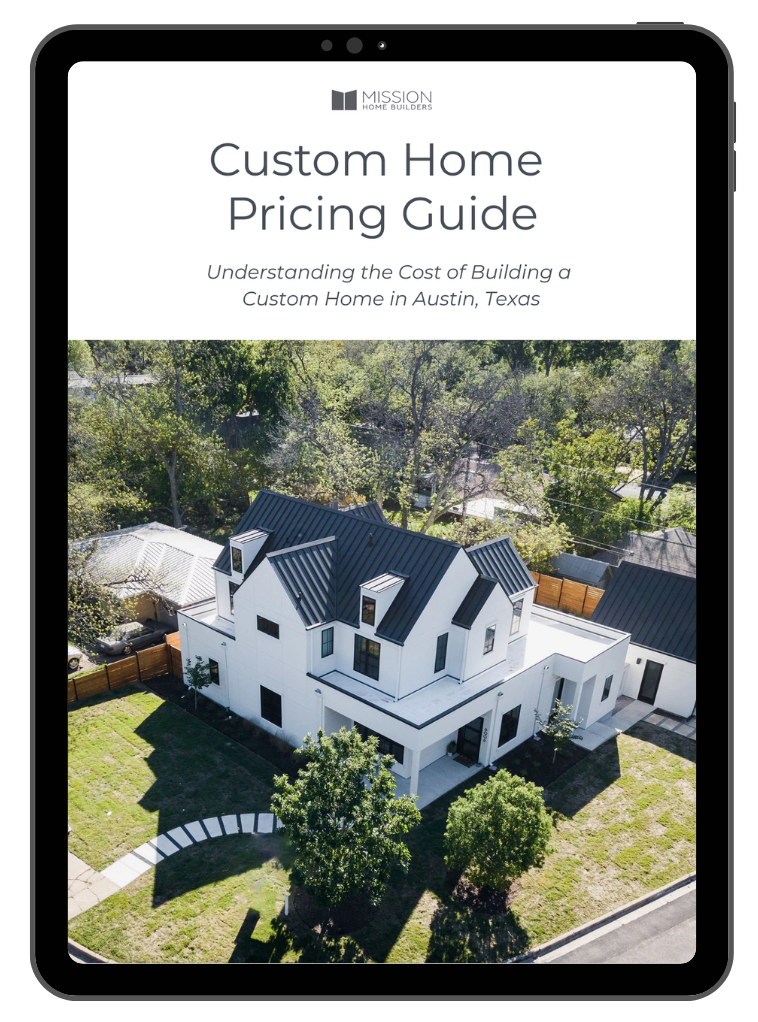
Custom Home
Pricing Guide